Buildings
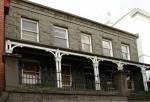
East Melbourne, Gipps Street, 015, Faraday House
Date built: 1870
Architect:
Builder: W.H. Kelly, 9 Collins Street West
East Melbourne, George Street, 187
Date built: 1881
Demolished:
Architect: Crouch & Wilson
Builder:
First owner: Bernard Marks
Description: Rate books describe it as a brick house of twelve rooms
History:
Past occupiers:
1881-1900+ Bernard Marks
Refs:
City of Melbourne Rate Books
Melbourne Mansions database: http://fmpro.abp.unimelb.edu.au/ Ref 1392
East Melbourne, George Street, 179, Ulswater House, Kilmaurs
Date built: 1867
Demolished:
Architect:
Builder: Peter Reid, Carlton
First owner: William Hindson
Description: A photo in 'We of the Never Never with a memoir of Mrs. Gunn by Margaret Berry' shows the house as a large two storey house with a verandah and balcony with cast iron decoration on the west side; and on the east a simple rendered facade with a pair of arched windows above and below. Rate Books describe it as a brick house of twelve rooms. A sale notice in the Argus of 27 Oct 1877 describes it as bluestone.
History: Mrs. Aeneas Gunn, author of Australian classic, We of the Never Never, occupied the house with her two sisters, Elizabeth Christine Taylor and Carrie Templeton. We of the Never Never with a memoir of Mrs Gunn by Margaret Berry describes the household of "three middle aged very abstemious ladies with a maid". There are photos of the house, and author in the garden. Margaret Berry (nee Derham) was Jeannie Gunn's niece. The house had been the family home of John Montgomery Templeton and his second wife, Carrie (they married in 1905) until his death in 1908. John named the house after his birthplace - Kilmaurs, Ayreshire, Scotland. The house was sold on the death of Carrie in 1931.
Past occupiers:
1867-c.1877 William Hindson and family including John Hindson, stock and share broker
1878-1885+ J.R. Tuckett
c.1890-1900+ Charles Smith
c.1905-1908: John Montgomery Templeton and his wife, Carrie
1910-1931: Mrs. Aeneas Gunn (Jeannie Taylor); Elizabeth Christina Taylor; Carrie Templeton (neeTaylor)
Refs:
We of the Never Never with a memoir of Mrs. Gunn by Margaret Berry, Hutchinson, Richmond, Vic., 1983
Melbourne Mansions database: http://fmpro.abp.unimelb.edu.au/ ref 891
City of Melbourne Rate Books
Electoral Rolls, Melbourne division, Melbourne sub-division
Burchett index of Intents to Build, City of Melbourne, 8 Oct 1866
The Argus, 27 Oct 1877, p.2
The Argus, 7 Sept 1931, p.2, Judicial and Law Notices:
http://ndpbeta.nla.gov.au/ndp/del/article/4427814
Australian Dictionary of Biography online:
Otto Kristin, email to Sylvia Black 12 May 2009.
East Melbourne, George Street, 171-175
Date built: 1878; c.1881
Architect:
Builder:
First owner: Robert R. Rodgers, sharebroker & land agent of 53 Elizabeth Street, Melbourne
Description: A terrace of three two storey houses
History: The land the houses are built on was previously occupied by a four roomed iron house, with two attics, a kitchen and offices. The houses were built at different times. 173 and 175 first appear in the Rate Books in 1878, and 171 in 1882. By the 1970s all houses had had their cast iron balconies and fences removed and replaced with very plain contemporary iron work. Victorian-style cast iron has been re-instated at 173 and 175, but 171 now has no balcony.
The stairwell at 171 bears (or did once?) a mural painted by Melbourne-born artist, Mary Talbot. It is (was) a painting of a young girl's face, with plant-like tendrils for hair.
Past occuiers:
1878-1889: Robert R. Rodgers occupied 175.
Refs:
City of Melbourne Rate Books
Burchett Files, East Melbourne Library
The Age, 9 Nov 2009 (photocopy in Street Files, East Melbourne Library)
East Melbourne, Hotham Street, 080, Sydenham House
Date built: 1855; 1856; 1879
Architect:
Builder: William George Roberts - Franklin St.
First owner: William George Roberts, teacher, member of committee of Trinity Church, East Melbourne
Description: Two storey free standing house. Symmetrical with arched windows, no verandah.
History: In 1855 Roberts applied to erect a corrugated iron house, described in the rate books as three rooms and a kitchen In 1856 he built a brick cottage behind. In 1879 Mrs. Roberts commissioned builders Marshall & Son of 14 Gore Street, Fitzroy to build a brick house which replaced the corrugated iron house, and in effect became an extension of the brick cottage.
An advertisement in the Argus reads,
Ladies Institute, Sydenham House, Hotham-street, East Melbourne. Principals - Mr. and Mrs. William George Roberts. Established 1855 for first class education. Vacancies for wo... boarders.
William George Roberts (born Germany c.1814) died in 1876 but his wife, Margaret Roberts (born c.1823)remained in charge of the school until its closure in 1900. Her three unmarried daughters, Edith Annie (born c.1847), Lillian Margaret (born c.1850) and Nina Beatrice lived with her and no doubt assisted with the school. Mrs. Roberts died in 1901 leaving the house, then valued at 1,100 pounds to her daughters. The family continued to occupy the house until the mid 1930s.
William and Margaret Roberts and their two oldest daughters arrived in Melbourne in 1854 aboard the Sussex
Refs:
Burchett index of City of Melbourne, Intents to Build: 22 February 1855, Reg. No. 221; 2 July 1879, Reg. No. 8029
The Argus, 18 July 1860, p. 3.
Memorial printed and circulated by the Committee of Trinity Church, 7 December 1870.
Will of Margaret Roberts available online through website of Public Records Office of Victoria: http://www.access.prov.vic.gov.au Series No. VPRS 7591; Consignment No. P0002: Unit No. 321
Burchett, Winston, East Melbourne Walkabout, Cypress Books, Melbourne, 1975
http://proarchives.imagineering.com.au/index_search_results.asp viewed 12 Aug 2009
East Melbourne, Hotham Street, 072-76, Queen Bess Row
Date built: 1886-7
Architect: Tappin, Gilbert & Dennehy
Builder: A.J. Muller
First owner:
Description: Three four storey houses of red brick with sandstone dressings built in the Queen Anne Revival style. Elaborate facade details (for further see Australian Heritage Place Inventory, website below).
History: The building permit application submitted by a Miss Cornwall was for three four storey houses although it seems the building never functioned in this way and the plan was merely a fallback position. The party walls between the houses were designed with archways between them to allow for easy opening up or closing off. The caption to an illustration in The Building & Engineering Journal, 21 July 1888, describes the building as the East Melbourne Coffee Palace, and this name is also written below the central gable of the building. However it appears that while a coffee palace was the intended usage it was never the reality and it eventually opened as a boarding house with a Miss Macartney as manager.
The land on which Queen Bess Row was built was bought in the original land sales of 1853 by WJT Clarke. In 1895 his son, Joseph Clarke, is listed as the owner. He died the same year and the property was held by the Clarke Trustees.
The archways were blocked up in 1896, and the building was converted to apartments with one apartment on each floor of each house. Although not built as apartments the building is regarded as possibly Melbourne's first apartment block.
By the the late 1920s the buildings were known as Rubra Flats (72), Angus McArthur's boarding house (74), and Cregh Flats (76). By 1936 No. 74 was known as Tudor Guest House.
In 1989 the building ceased operating as a 50-room boarding house, home to low-income tenants. Following prolonged feuding between the Ministry of Housing and the Melbourne City Council, and amid much opposition from tenants, would-be tenants and their defendants, the building remained empty for a year. In 1990, it was finally subdivided into three separate houses and sold to individual purchasers.
Refs:
Australian Heritage Place Inventory: http://www.heritage.gov.au/ahpi/index.html
Lewis, Miles, Suburban Backlash, Bloomings Books, Hawthorn, Vic., 1999
Rushen, Liz. A short untitled MS on the history of the houses written as a caption for an exhibition of photos: EMHS VF 244
19th century MMBW plans of East Melbourne published
Index to MMBW plansWith the permission of the State Library of Victoria, the East Melbourne Historical Society has published a (nearly) full set of MMBW plans drawn between 1895 and 1900 covering East Melbourne. The easiest way to access the plans is from the Index to MMBW plans.
The plans are highly detailed showing house outlines, out-houses, facilities, pipes, drains, ground surface types and many other details applying at the time. As a historical record of East Melbourne they are extremely informative and quite unique.
East Melbourne, Hotham Street, 172
From The Australian Home Beautiful, May 1956, pp. 34-37. Real Life Renovations. "Dream House was not all Bliss" by Jane Cumming
Jane and her husband were owners of the house and she writes in the first person. Several photos accompany the article.
East Melbourne, Hotham Street, 044, Chandos
Date Built: 1885
Architect: Nahum Barnet
Builder: Langford and Hutchison
First Owner: David Benjamin
Description:
History: David Benjamin never lived in the house, it was an investment property from day one.
East Melbourne, George Street, 108, Varzin
Date built: 1877
Date demolished: 1960s
Architect: James Thomas Conlon