Community
Stories of East Melbourne.
East Melbourne Library site - Past and Present
An address to the Historical Society by Marga Macdonald, long time resident of East Melbourne and a founding member of the advisory committee for the new East Melbourne Library and Community Centre.
December 2006
Community centre
I am really pleased to be here tonight in our beautiful new Community Centre celebrating Xmas with you.
I don't think any of us 6 or so years ago when we started planning for this, thought that we would end up with something quite so large, amazing and so full of character. Since its opening in August you, the historical society and the others, bridge, book group, children corner, garde, etc., have really shown how much East Melbourne needed a focus point, a centre that was our own.
At this point I am going to put in a plug for Elizabeth Cam and her monthly "Friends of the Library" morning tea.
Ghosts
Jill asked me to talk about the library and the site on which we stand. Like most of East Melbourne it has a lot of ghosts attached to it. However, this proved easier said than done and made me realise what an awful lot of history of our area has been lost for evermore and how important you, as a group are to make sure no more gets lost.
However, thank heavens for Winston Burchett who did record quite a lot in the 70's. He has only a snippet about this site and as I tried to find out more I realised why it was so patchy and hard to get - because it aint there!!!
East Court
The original house on this site of ours was called East Court and was built about 1857 for Alexander Beatson Balcombe, grandfather of Dame Mabel Brookes. It was a large site going right to Powlett Street. The Balcombes had estates on St. Helena called "The Briars" and Napoleon lived in a pavilion on the estate and became a friend of the family. Alexander Balcombe's father had to leave St Helena as he was suspected of being an intermediary in clandestine correspondence with Paris and after a stint in England he came to Australia. Alexander Balcombe took up land at Mt Martha on the Mornington Peninsula in 1840, built a rough-hewn slab house, the forerunner of what is still there today and open to the public, The Briars is well worth a visit and you could take in Beleura at the same time. The family prospered and Mrs Balcombe moved to East Melbourne sometime in the 1850s, first into a prefabricated house which supposedly originated in India. I suspect she was somewhat more comfortable here than at the Briars. The Balcombes had 2 sons and 5 daughters so a fairly large house was needed and the new house at East Court was built about 1857. Dame Mabel Brookes describes East Court as a hospitable place, where the front door was never closed. The main house stood immediately in front of the prefabricated house, and served as kitchen quarters, and food was transported on trays to the dining room in the main house by a myriad of domestics. It was not uncommon in those days to have the kitchen separate due to the risk of fires in the kitchens. The main house was typically Victorian, huge and stuffy. Lots of silver, antimacassars, carved emus eggs etc. But it did have some of the furniture used by Napoleon on St. Helena, a teak table used by both Wellington and Napoleon, and a writing desk bearing Napoleon's kick marks on the lower panels. I remember once hearing that Dame Mabel was once asked what three things she would take if her house went up in smoke, and she said "jewels, photographs and the death mask of Napoleon. The Briars has some of these relics on display.
Mrs Balcombe
Mrs Balcombe was a very outgoing woman, she spent lavishly on charities and, according to her granddaughter had a perennially over drawn account at the bank. She had many friends including a Miss Gibbs, who lived in the house as a companion and Mrs Perry, the Bishop's wife, of Francis Perry House fame amongst other philanthropic works. She was also a friend of Mrs Latrobe, though this must have been before the main house was built in 1857 as Mrs Latrobe went back to Europe in 1854 but the two are supposed to have swapped plants and seeds and the Balcombe and Latrobe children played together. After all it was only a short walk across fields and scrub to the two houses.
Mrs Latrobe
In 1839 Superintendent Latrobe, as he then was, later to become Lieutenant Governor, had decided that the conditions in town were unsavoury and selected land in what is now Jolimont, amongst the gum trees. Mrs Latrobe on seeing the area supposedly said "Au Jolie Mont", and so it remains. The Latrobe house was also a prefab, imported from England in two parts. Mrs Latrobe was a keen gardener and it must have looked lovely with its flower gardens and overlooking where the Botanical gardens now are. There is a wonderful picture of the house and garden in the State Library with two ladies conversing under an arbour. I'm sure you all know the sad history of the Latrobe house, how it fell into disrepair, was in the Bedggood Shoe factory grounds and was removed in 1960 to its current position in the Domain. Not visited very often but well worth a visit. I'm told that the Latrobe's had a holiday house at Queenscliff. I haven't been able to find out where but somewhere on the cliff, which must be where the fort is now. Prime real estate. Mrs Latrobe, who9 was Swiss herself, encouraged and organised Swiss vignerons to plant the first vineyards in the Barrabool hills. They were unfortunately wiped out by the Phylloxera scourge of the 1870's. Mrs Latrobe, not in good health, went back to Switzerland, her home of birth, and died there in 1854.
Cairns Memorial Church
A monument to Mrs Latrobe was on the wall in the Cairns Memorial Church, now the Cairns apartments, and told the story of "Oh Jolie Mont!" The Cairns Church was another interesting place, which went up in great sheets of flame in 1988. The church was built in 1883 by Twentyman and Askew and was a centre of Presbyterianism. My sister-in-law, who was a boarder at P.L.C. when it was in E. Melbourne, remembers walking in a crocodile to church, hats and gloves at the ready. There were wonderful memorials on the wall to sea-farers and other old timers, it had a very small congregation in the 70's 80's but it had a wonderful basement. It was where we went to vote, all sorts of groups had meetings there, the Highland dancers, the stamp and coin collectors the train society, and, I remember, the Love Bird Society! We took our children and a couple of cousins who were staying with us there one Sunday when we first arrived in East Melbourne And the verger rubbed his hands with glee and announced, "Now we can start the Sunday School again!" The children refused to go back! The inferno was so great when it went up in flames and not one record was saved.
Lanivet
But back to this site. Mrs Balcombe died in 1907 and East court had two owners in fairly quick succession. It had a series of owners over the next 60 years, and its fortune waxed and waned as did East Melbourne. It's name was changed at some stage to Lanivet and its last private owner appears to have been a Miss White who was there for about 15 years . Cido, our librarian, told me that a lady he spoke to one day told him that she remembers as a child "The Ghost House" which had an overgrown garden and had an old lady living there. The only thing I can find out about Lanivet is of a small town in Cornwall of that name so can only assume that one of the owners had some connection there. The East Melbourne Library was then opened there on 29th May 1964.
Original Library
The little old cream brick library served us well for many years but as East Melbourne changed so did the needs of the people and time and technology caught up with it. We moved into East Melbourne in 1971 and lived directly behind the library, and the children used to climb over the back fence to get there. One time my young daughter nearly spent the night there as the Library shut and she was left unnoticed reading in a beanbag, fortunately seen by the Librarian banging on the window as she was driving out!! It was a friendly little place but we outgrew it and we still didn't have a centre for community activities.
Plots and plans
In the 1990 there was talk of the Melbourne City Council getting rid of our library, amalgamating us with Richmond or Fitzroy, and selling off the land. We think a developer must have been in the wings!!! There was also talk of a central city library and we could use that. There were library meetings of local residents to campaign not to close but then the Council changed tactics and asked the East Melbourne Group to get involved. I was a member of the East Melbourne Group Committee at that time and Nerida Samson, our worthy president, asked me to take on the Library Advisory Group, as it was then called. We organised a public meeting, to which about 20 people came, formed a committee of locals Irene de Lautour, Frank and Penny Lewis, Fiona Wood, Peter Moon and myself. We had one particularly helpful member of the Council, Maurice Bellamy, who was our liaison with the rest of Council, They provided the money for a professional postal survey, which some of you may remember, so that we could find out what it was that the suburb really wanted. It came out overwhelmingly that an enlarged library was wanted and an area where people could meet socially and for group activities. The Council then totally came out supporting us and money was set aside in the budget for a new building. We had many, many meetings with all the players, the Yarra Melbourne library bosses and our own library staff who were always most helpful, the various local groups, yourselves included, the Council who allocated the money in their budget, town planners, architects etc., and it finally all happened. There were several changes of plans. I remember at one stage there was a rather strange conveyor belt to the children's area, which had to go. We had to deal with complaints, of which there were not many actually. The proposed café was a source of contention and had to go which was a pity but in the end we got there.
New Library and Community Centre
The East Melbourne Group with first of all Nerida, and later, Margaret Wood as President, supported us in all our efforts. Irene de Lautour and myself left the Committee after about 15 months and left the others to do the rest of it, with Peter, and later Frank, as their Captain. And the result - what we have today!
I know there are problems, things that niggle and aren't quite right; the air-conditioning, the catering facilities to name but two. Rob Adams, the principal Architect is away overseas till January and has promised to look into it all on his return. I built a house at Queenscliff which was finished last February and the builder and I are still working on bits so it takes time. In the meantime we, East Melbourne, have a wonderful facility of which we can be justly proud.
Enjoy it!
HAPPY CHRISTMAS!!!
Yarra Park, from Go to Woe
When Charles Joseph La Trobe arrived in Melbourne in 1839 as the newly appointed superintendent of the colony of Port Phillip he would have found the north bank of the Yarra, just east of the city, to be bordered by swamps and lagoons rising gently to open scrubland dominated by large river red gums. He would have seen aborigines from the local Wurundjeri clan hunting and fishing in the lagoons; and occasionally he might have seen a corroborree as neighbouring clans joined them in celebration.
He immediately recognised the potential of the area for recreational use and proposed that approximately 240 acres stretching, in modern terms, from Punt Road to Princes Bridge, and northwards to Wellington Parade and Flinders Street, be reserved for that purpose. However it was not until 1873 that this visionary proposal was ratified by an Act of Parliament. By then the original 240 acres had suffered several excisions.
La Trobe, himself, made the first cut when he bought his Jolimont land in 1840. Next, in 1853, the Melbourne Cricket Ground was given permissive occupancy of nine acres which was formally recognised as a Crown Grant in 1867.
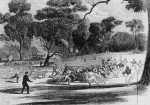 1866 Richmond Paddock
Australian football matchIn 1858 the first game of Australian Rules Football was played in Richmond Paddock, or Yarra Park, between Scotch College and Melbourne Gammar. However it was many years before the game was allowed to be played at the MCG as its turf was considered too delicate for the rough and tumble of the new game.
A stand built at the MCG in 1876 was reversible which could be made to face the MCG in summer for cricket, or the Richmond Paddock in winter for football. It burnt down in 1884.
In 1859 the railway line to Richmond effectively cut the park in half lengthways. In the same year land was reserved for the Swan Street extension, although it was not built until 1875. Thirty three acres to the south of this was given to the Acclimatisation Society which gave way to the Friendly Society Gardens when the animals were moved to Royal Park two years later as the start of the Zoo. Now that area is Olympic Park.
The Acclimatisation Society was linked to the Botanical Gardens by a foot bridge over the Yarra, and passengers on the Richmond line were once able to alight at the Botanical Gardens Railway Station, and from there it was just a short walk to either destination. The old railway bridge in Yarra Park, although much lengthened now, is a relic of those days. The land on the corner of Punt Road and Wellington Parade, which had once been the police barracks and gaol, was also excluded from the grant. A section of it was granted separately for a state school. The remainder was subdivided into 83 residential allotments and sold in 1881.
The remaining land when it was finally reserved in 1873 was gazetted as two parks, one each side of Jolimont Road, which then ran to the river and Branders’ ferry. Flinders Park was to the west, replacing the Police Magistrate’s Paddock where Captain Lonsdale had built his cottage; and Yarra Park to the east, replacing the old Police, or Government, Paddock, also known as the Richmond Paddock, where the police horses had once grazed. Yarra Park also included the parcel of land to the south of Swan Street known as Gosch’s Paddock.
Modern encroachments have reduced the size of the park even further. The MCG’s girth has expanded considerably. And the tennis centre, or Melbourne Park, once called Flinders Park because that is where it was, has slipped into Yarra Park with the building of the Vodaphone Arena in 2000.
The 1956 Olympic Games marked the beginning of Yarra Park’s degradation. This was the first time visitors to the MCG had been allowed to park their cars in the park proper. Previously parking had been limited to the corner formed by Brunton Avenue and Jolimont Street. The Council was very pleased with this clever solution and has never looked back, and except, ironically, for the hugely successful banning of car parking during the 2006 Commonwealth Games, cars now fill Yarra Park every time the MCG is used. The result is bare, compacted earth and suffering trees; a far cry from the thriving natural environment La Trobe hoped to bequeath to the citizens of Melbourne for their recreation and pleasure.